


When Safety Becomes an Excuse for Over-Regulation

Inroduction
Nearly twenty years ago, a New Zealand coroner asked a question that remains just as relevant today:
how many people had died after taking vitamins, minerals or herbal products?
It was a sensible question because the Government of the day was preparing to place New Zealand’s natural health industry under a new trans-Tasman regulatory regime, and safety was being used as one of the principal justifications. Before constructing an expensive regulatory machine, it seemed reasonable to establish the size of the problem it was supposed to solve. Unfortunately, I had lost the report that he produced, because it remains relevant to this day
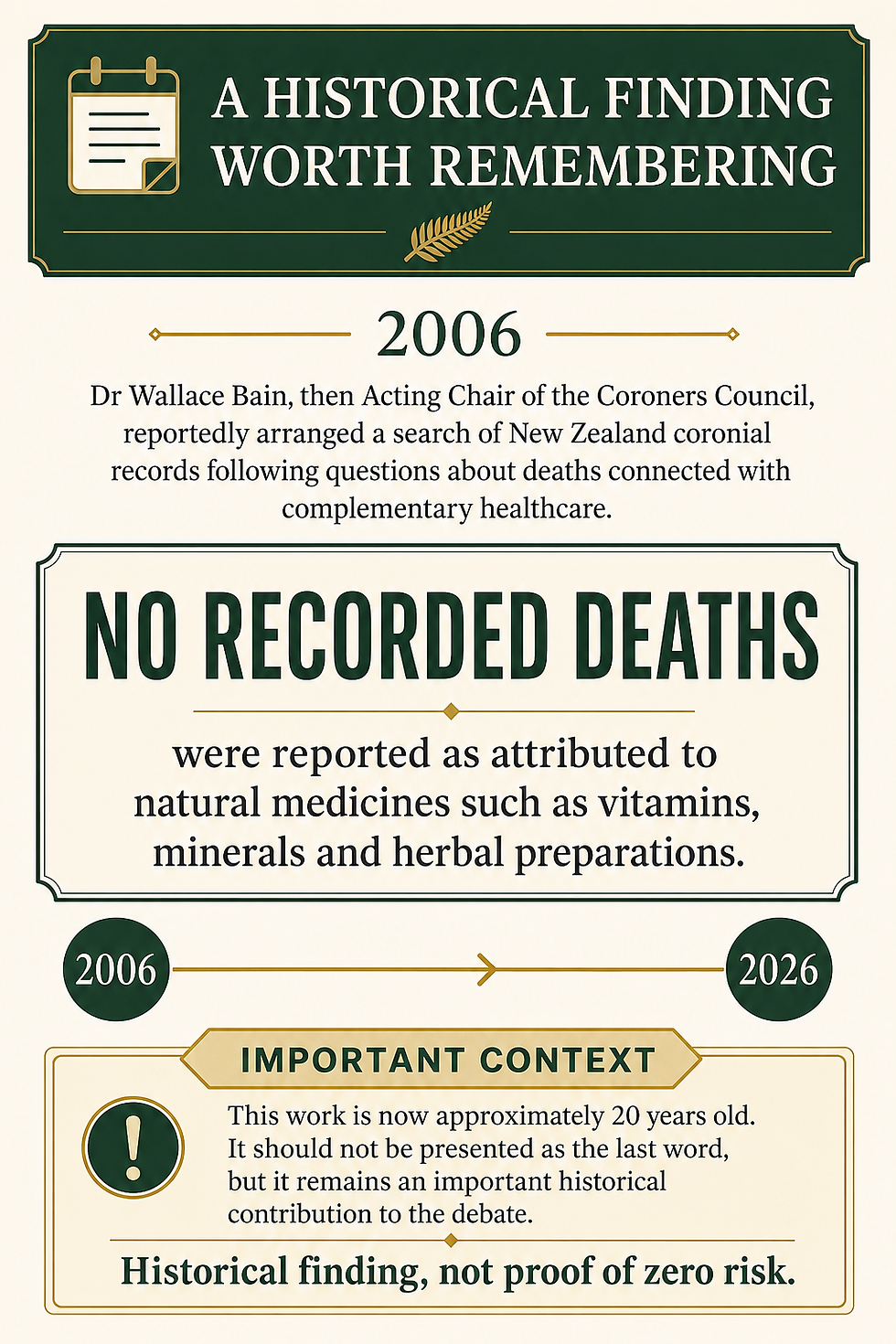
Fortunately, a helpful reader and supporter of my work unearthed several articles and reports from 2006. At the centre of them was Dr Wallace Bain, then Acting Chair of the Coroner’s Council, as well as a trained pharmacist and lawyer. Dr Bain asked New Zealand coroners to search their findings for cases involving natural health products. Ministry of Justice records were also searched at his request. According to the resulting report, the coroners could not identify a single New Zealand death that had been directly attributed to the proper use of vitamins, minerals or herbal products.
That finding was promoted under the headline, “Natural medicines: the safest way to avoid death”. It was a wonderful headline if one happened to oppose the proposed regulation, but few people ever got to hear about it - did you? The investigation was significant, for the debate over the need to keep us safe from natural health products, but you could say it got buried, as these things tended to then and moreso nowadays.

Before constructing an expensive regulatory machine, it seems reasonable to establish the size of the problem it is supposed to solve.
What the coronial search found
The 2006 report described three cases that came to attention. One involved a three-year-old child who tragically choked on a vitamin tablet. Another concerned a pregnancy affected by spina bifida where the mother had reportedly taken less folic acid than recommended. The third involved a man who died from non-viral hepatitis while also taking an Indian herbal preparation known as K4, although the coroner could not establish that the product caused his death and recommended caution until more was known.
Even these examples illustrate why health statistics must be read carefully. A child choking on a tablet is a genuine tragedy, but it is not evidence that the vitamin inside the tablet was toxic. A product being present when a person becomes ill does not prove that it caused the illness. On the other hand, the absence of certainty does not prove innocence either. Causation in health is rarely as accommodating as we would like it to be.
There are also obvious errors in the published report. It refers to folic acid doses of 300 and 800 milligrams when the intended units were almost certainly micrograms. Eight hundred milligrams of folic acid would be a heroic dose indeed, more likely to frighten the pharmacist than reassure the pregnant mother. This kind of mistake does not invalidate the entire coronial search, but it reminds us that the document was an advocacy release prepared during a political contest, not a polished epidemiological paper subjected to peer review.
The careful conclusion is that a search of the available New Zealand coronial records did not identify a single death directly attributable to natural medicines as defined by the investigators. Given how widely vitamins, minerals and herbal products were already being used, that was reassuring. It suggested that their fatality burden was very low. What it did not prove was that every natural product was harmless, that every adverse event had been recognised, or that no regulation was needed. What was obvious, and any natural health practitioner can affirm this, is that the risk profile of natural health products, including things like vitamin C, magnesium, and zinc, when taken as advised, have a far lower risk profile than pharmaceutical medicines. The main side effect of natural health supplements is looking good and feeling great. Just saying.
The coronial search found no New Zealand death directly attributable to the proper use of vitamins, minerals or herbal products.
Zero identified deaths is not the same as zero risk
however, let's not jump to conclusions when reading the coroner's report. To calculate a death rate, we need both the number of events and the number of people exposed. The 2006 report did not provide a denominator showing how many New Zealanders used natural health products, how frequently they used them, what doses they took, or for how long. It also did not provide a complete method explaining the years searched, the terminology used or how deaths involving several medicines and supplements were classified. Therefore, the claim that natural medicines had the “lowest fatality rate of all medical treatments” went beyond what the investigation itself could establish.
There is another difficulty. Coronial records are reasonably good at identifying sudden and unusual deaths, but they are not designed to capture every non-fatal adverse reaction. A herbal extract might occasionally contribute to liver inflammation, a mineral might interfere with a prescription medicine, or an imported product might be contaminated or inaccurately labelled. Unless the connection is suspected, investigated and reported, it can pass unnoticed.
We now have New Zealand examples demonstrating that such harm, while uncommon, is possible. In 2018, Medsafe reported 25 cases of liver toxicity associated with products containing an extract of Artemisia annua. The reactions included hepatitis, jaundice and abnormal liver function. Medsafe estimated the risk at approximately 0.5 to 6.3 cases per 10,000 consumers, depending on the assumptions used. Most people recovered or were improving after stopping the product, but the episode demonstrated that a natural origin does not grant a substance diplomatic immunity from human physiology. Nobody died. Medsafe’s safety communication
But before you jump to conclusions that the product containing Artemisia annua was the sole cause of these 25 cases, think again. For starters, the product identified was called Arthrem. Arthrem was a highly concentrated extract of the herb and was being dispensed primarily through pharmacies with claims of medical benefits for conditions like arthritis, and dispensed as if it was a pharmaceutical drug, with a potency many times greater than could ever be achieved by the herb in its natural form. And despite this, the liver issues could not be entirely attributed to the drug on its own. Please take a few minutes to read my own report on this and related issues, then make up your mind about whether banning Artemisia was justified. My opinion is this: Instead of banning HTMA-sir, they should instead have banned Athrem alone. But instead, they targeted the product in its entirety and, for what I felt, was for ulterior motives: and that was to clear the way for the scandalous Emergency Use Authorisation of experimental COVID mRNA drugs.
Zero identified deaths does not mean zero risk, but it does suggest that the fatality burden of natural health products is remarkably low.
Risk must be kept in proportion
Acknowledging occasional harm is not an argument for placing every vitamin, mineral, herb and traditional preparation under the same regulatory burden as a new pharmaceutical drug. It is an argument for intelligent regulation based on the nature and magnitude of the risk.
A high-dose isolated substance, a concentrated herbal extract and an ordinary food-derived nutrient should not automatically be treated as though they present identical hazards. Nor should a traditional herbal tea be subjected to the same approval process as a novel synthetic medicine intended to alter a major physiological pathway. Good regulation distinguishes between them. Poor regulation begins with a large administrative hammer and spends the next decade searching for nails.
Regulation also produces its own risks. Compliance costs do not disappear into the Wellington mist. They are eventually paid by consumers through higher prices, by small businesses that can no longer afford to remain in the market, and by practitioners and manufacturers who decide that innovation is no longer worth the trouble. Large multinational companies can employ regulatory departments and lawyers. A small New Zealand producer making a high-quality traditional product may have the owner, a part-time bookkeeper and a dog. Both businesses should meet appropriate standards, but pretending they have the same resources is regulation written for the convenience of regulators rather than the public.
This was one of the concerns behind the opposition to the proposed trans-Tasman authority in 2006. Critics feared that New Zealand would inherit an expensive Australian-style system that would favour large corporations while removing many low-risk products from the local market. Regulation can improve safety, but it can also restrict choice, raise prices and quietly transfer control of a market from small producers to organisations large enough to absorb the paperwork.
Good regulation distinguishes between levels of risk; poor regulation begins with a large administrative hammer and spends the next decade searching for nails.
New Zealand is still wrestling with the same problem
The regulatory furniture has been moved around several times since Dr Bain conducted his search, but the room still looks familiar. The Therapeutic Products Act 2023 was intended to replace older legislation and introduce a broader regulatory framework. It was subsequently repealed after the incoming Government concluded that parts of it would impose unnecessary costs and over-regulate lower-risk products, including natural health products. I played a role in the repeal of this legislation. You can watch all of the videos here of the public meeting that brought New Zealand First onto the side of the natural health industry of New Zealand.
Dietary supplements continue to be regulated through existing food, supplement, labelling, manufacturing, importing and biosecurity requirements. The Government has also indicated that a separate natural health products framework is being developed following engagement with the sector. Ministry of Health regulatory update
New Zealand does need mechanisms for dealing with contaminated products, adulteration, misleading labels, undisclosed pharmaceutical ingredients and manufacturers who make extravagant claims without adequate evidence. Consumers should be able to identify what is in a product, where it was made, how much they are taking and whom to contact if something goes wrong. Enforcement should concentrate on actual hazards and dishonest conduct rather than things like prosecuting technical infringements into a substitute for protecting health. Current laws work well, but only if they are properly applied.
Guess what? I reckon the current consumer protection laws that exist are more than adequate for ensuring the safety of New Zealanders when it comes to natural health products. If you are concerned about deaths and injuries, from Medicines and Supplements, then focus on pharmaceutical medicines. That's where the real problem lies, and stop trying to lump natural health products in with these things that clearly cause excessive harm.
I feel there is a war against all things natural, and the enemy of natural health, which has enormous power and influence, is resorting to tactics best described as being "divide, then conquer".
The laws we already have can protect New Zealanders, provided they are properly enforced against genuine hazards and dishonest conduct.
Comparing like with like
The natural health debate has degenerated into two rival camps throwing rotten tomatoes at each other. One side implies that anything natural must be safe because it came from a plant. The other behaves as if an unapproved bottle of magnesium is lurking in the bathroom cabinet waiting to bring down civilisation. Neither position is particularly helpful, but I think this is intentional.
Modern medicine saves lives every day. Emergency medicine, antibiotics, anaesthesia, surgery, insulin and many other treatments have transformed human survival. These interventions also carry risks, some of them considerable, which may be entirely justified when treating a serious illness. The correct comparison is not “dangerous drugs versus harmless supplements”. It is the likely benefit, likely harm and available alternatives in the circumstances of the person being treated.
Natural health products deserve the same intellectual honesty. Many have excellent safety records and can help correct nutritional insufficiency, support normal physiology or improve wellbeing. Some have limited evidence. Some are poorly manufactured. A few are inappropriate for particular people, especially during pregnancy or when liver disease, kidney disease, heart problems or prescription medicines are involved. Dose, product quality, and the person taking it must be considered.
The mistake is to regulate according to category and prejudice rather than evidence and risk. A product should not receive a free pass because its label includes a leaf, but neither should it be treated as a dangerous drug merely because it has been placed in a capsule.
A product should not receive a free pass because its label includes a leaf, but neither should it be treated as a dangerous drug merely because it comes in a capsule.
A sensible way forward
A balanced New Zealand framework would begin with product quality, honest labelling, traceability and accessible adverse-event reporting. It would distinguish foods and ordinary nutrients from concentrated substances with significant pharmacological activity. It would protect access to low-risk traditional and nutritional products while applying closer scrutiny to higher doses, novel compounds such as the now discontinued Arthrem, vulnerable populations and products making therapeutic claims.
It would also acknowledge that regulation is only part of safety. Practitioners and consumers need better education about dosing, interactions, contraindications and the importance of informing doctors about everything being taken. Manufacturers should be encouraged to test raw materials and finished products, maintain proper records and respond promptly to safety concerns. A responsible natural health industry should welcome these basic protections because one reckless operator can damage the reputation of thousands of careful ones.
Above all, regulation should solve a clearly identified problem - not one that is non-existent. Before introducing another layer of licensing, fees and restrictions, policymakers should tell the public what harm is occurring, how often it occurs and how the proposed measure will reduce it. They should also assess the cost of reduced access, higher prices and lost local businesses. Otherwise, safety becomes a word used to end debate rather than begin a proper examination of evidence.
But here's the thing: other than a few tweaks here and there, current consumer law is obviously providing the protections being asked for. And I'll tell you this: no reputable manufacturer, distributor, or practitioner in New Zealand would dare to prescribe products that do not meet New Zealand regulations. To do so will be the death sentence for their business for even the slightest of slip-ups. The NZ Muscle Scandal is evidence of this. As I said earlier, all that is required is for current laws to be applied.
Before imposing more licensing, fees and restrictions, policymakers should first identify the harm, measure its frequency and explain how their proposal will reduce it.
Free Range New Zealand
There is an opportunity for our government and public service to do the job properly, but I am sceptical. I wonder who our government and public service really work for. Are they serving the best interests of hard-working Kiwis, or the interests of large multinational corporations? As you consider that question, you will understand why I have put my money where my mouth is and created the Free Rangers movement. Our vision is for New Zealand to be the best place to live and to raise a family. We are creating a marketplace to fund the movement. As the freerangers marketplace develops, it will support small to medium-sized New Zealand-owned companies that align with our vision. Please support the Freerangers Movement. It is free to join - no subscriptions. It is self-funding.
Our vision is for New Zealand to become the best place in the world to live and raise a family, supported by strong communities and locally owned businesses.
Conclusion
Dr Wallace Bain’s 2006 coronial search should not be waved about as proof that natural medicines can never kill or injure anyone. That would ask the report to carry more weight than its shoulders were built for. It should instead be remembered as an early attempt to place regulatory claims against the actual evidence of harm. The search found no New Zealand death directly attributed to the natural medicines examined. That remains historically significant and strongly suggests that the recorded fatality risk was very low. That is my conclusion, and it remains the same today.
New Zealand needs sensible standards, honest labels, responsible manufacturing and effective action against dangerous or fraudulent products. What it does not need is a costly regulatory empire built on the assumption that every low-risk nutrient and traditional remedy is a pharmaceutical wolf wearing rosemary around its neck. The principle should be simple: regulate according to evidence, severity and probability of harm. Protect people from genuine danger, preserve access to low-risk products, and do not crush responsible New Zealand businesses under rules designed for risks they do not create.
Regulate according to the evidence, severity and probability of harm, while preserving access to low-risk products and protecting responsible New Zealand businesses.
Please share your thoughts in the comments section below this article. Thank you.
For your entertainment:
Medical disclaimer
This article is provided for educational and public-policy discussion only. It is not personal medical advice, diagnosis or treatment. Natural health products can cause adverse reactions and interact with medicines. Consult an appropriately qualified healthcare professional regarding your circumstances, medications and health conditions.


Comments