


Wellington’s Water Bill - When the Money Tree Finally Runs Out

Updated: Aug 27
(Updated 27th August, 2026)

Introduction
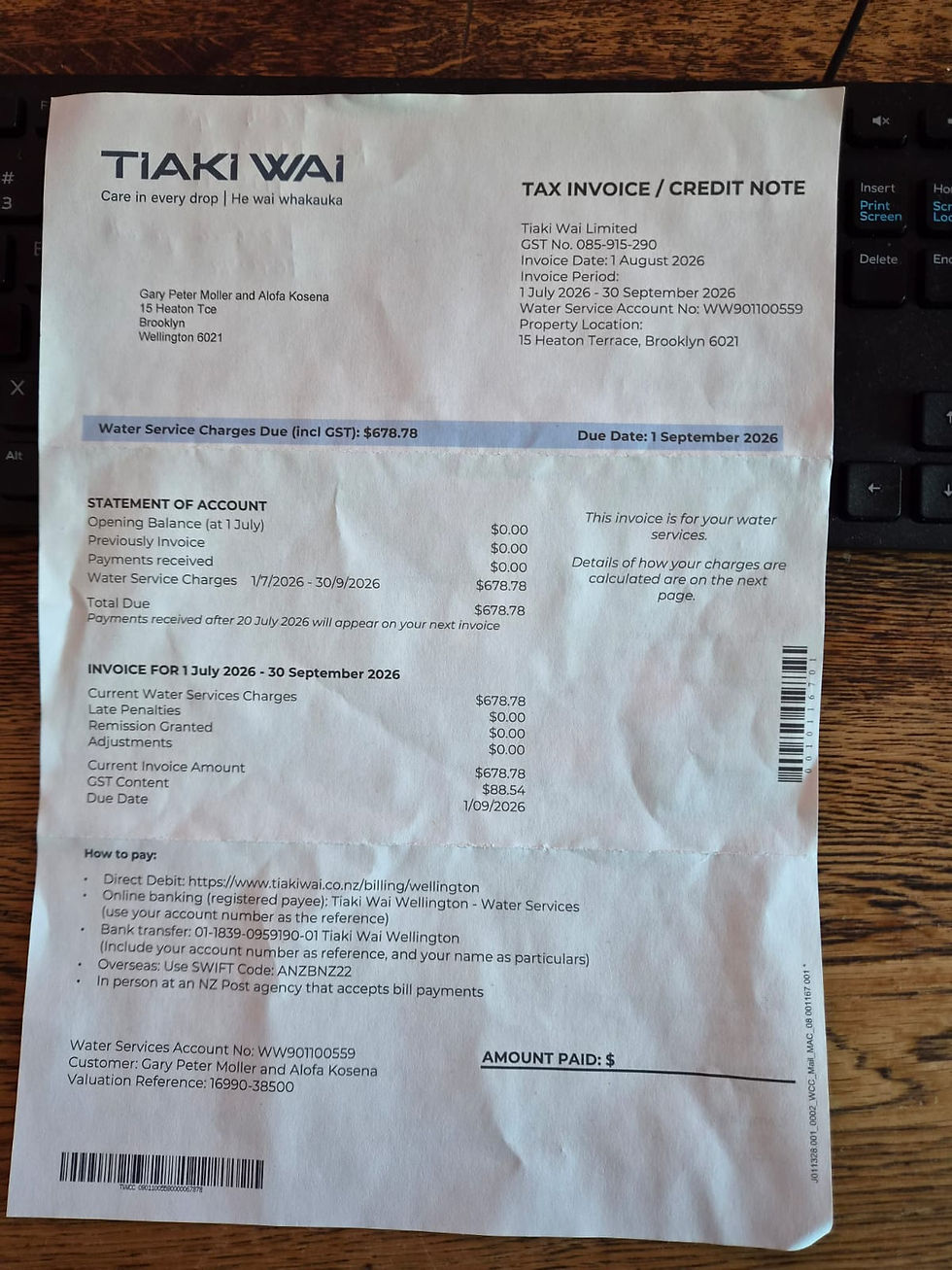
From 1 July 2026, property owners throughout Wellington, Porirua and the Hutt Valley will receive a separate bill for drinking water, wastewater and stormwater from the new council-owned organisation, Tiaki Wai. Our's arrived today. These costs are presently collected through council rates, so the councils will remove the water component from their rates bills. However, this is not merely an accounting exercise in which the same amount of money moves from one invoice to another. The overall cost to households will rise, and for many homeowners the increase will be substantial.
Tiaki Wai has confirmed that the average household water charge across the four cities will be approximately $2,390 a year. This compares with an average of about $2,100 currently collected through council rates, although the amount paid by each property will vary according to its location, capital value and existing council charging method. During the first year, most households will not be charged according to their actual water consumption. Instead, Tiaki Wai will largely continue using the existing mixture of fixed charges and property values. Property owners can obtain an estimate using the Tiaki Wai water charges calculator.
The True Cost Is Hidden in the Arithmetic
For our Wellington household, the first Tiaki Wai invoice is $678.78, covering the three months from 1 July to 30 September. Nowhere on the front page does it plainly tell us that this equates to $2,715.12 a year, or $52.21 every week. To discover what the new arrangement actually costs us, we must find our Wellington City Council rates assessment, calculate the annual value of the water component removed from it, add the remaining rates to the annualised Tiaki Wai charge, and compare this total with what we were paying previously. Whether this presentation is intended to soften the blow or merely reflects bureaucratic thinking, it leaves busy and already stressed ratepayers to uncover the true annual cost for themselves.
Before the introduction of Tiaki Wai, our Wellington City Council rates were $634.48 per month, equivalent to $7,613.76 a year. From August, the council payment declined to $443.57 per month, or $5,322.84 annually, which may initially look like a substantial saving. However, when the annualised Tiaki Wai charge of $2,715.12 is added, our new combined rates and water cost becomes $8,037.96 a year. We are therefore paying $424.20 more than previously, an increase of approximately 5.6 per cent. The rates bill has certainly fallen, but once the separate water invoice is included, another $35.35 leaves our household every month, or $8.16 every week. That is the figure that matters because it represents the money actually removed from the family budget.
I am a hard-working pensioner in my mid-seventies, and with Wellington already experiencing a serious economic downturn, another compulsory expense is neither trivial nor welcome. Could I ever afford to retire while still living in Wellington Central? (Related article about energy costs).
Eight dollars a week may not sound devastating when viewed in isolation, but it arrives on top of increases in food, electricity, insurance, transport, home maintenance and almost every other household necessity. For some households it may remain manageable, but for others it will add to considerable financial stress and may be the latest of many modest increases that finally push an already stretched budget into deficit.
We should also be wary when politicians reassure us that the next increase will be “only 8 per cent”. An 8 per cent rise may sound almost harmless when presented as a single annual adjustment, but repeated year after year it becomes punishing because every increase is applied to all those that came before it. Over ten years, annual increases of 8 per cent do not raise a bill by 80 per cent; they increase it by approximately 116 per cent, meaning the cost more than doubles. Our present Tiaki Wai charge of $2,715.12 would grow to approximately $5,861 a year, while every $1,000 presently paid in council rates would become about $2,159.
Applying the same compounding to our actual combined rates and water cost of $8,037.96 would lift it to approximately $17,353 a year within ten years, equivalent to about $1,446 a month or $334 every week. Unless New Zealand Superannuation, wages and after-tax household incomes rise at a comparable rate, these apparently innocuous annual increases will steadily consume a larger share of the family budget. That is the quiet devastation of compounding: politicians may announce an increase of “only 8 per cent” each year, while the ratepayer discovers a decade later that the bill has more than doubled.
The Cost Does Not Disappear for Renters
Homeowners will see the new water charge directly, but renters should not assume that it has nothing to do with them. Property-based water charges are generally the landlord’s responsibility unless a tenant is paying for metered water that can be attributed to the tenant’s actual use. However, landlords are already absorbing higher rates, insurance, interest, maintenance and compliance costs. Over time, many will attempt to recover at least part of these increases through higher rents, insofar as the rental market and tenancy laws allow them to do so.
Other landlords may postpone maintenance, reduce investment in their properties or decide that providing rental accommodation is no longer worthwhile. Some may sell, further disrupting tenants and potentially reducing the supply of rental housing. The route by which the money is collected may differ, but somebody must ultimately pay. Costs imposed upon landlords do not vanish into thin air merely because the invoice is not addressed to the tenant.
The cumulative burden is what concerns me most. A household may be able to absorb another $5 a week here and $10 a week there, but these increases are arriving on top of higher food, electricity, insurance, transport, rates, rent and mortgage costs. Families do not experience these expenses as separate columns in a council spreadsheet. They experience them as a steadily shrinking amount left in the bank account at the end of each week, accompanied by the nagging anxiety that one unexpected repair, illness or loss of income may bring the household finances tumbling down.
Money Taken from Households Is Money Taken from Wellington Businesses
Every additional $1,000 collected from a household is $1,000 that cannot be spent elsewhere. It is money that will not go to the local butcher, café, builder, sports club, restaurant or retailer. Families will postpone home repairs, cancel subscriptions, eat out less often, reduce sporting and recreational activities, and think twice about supporting local events and charities. These may be labelled discretionary purchases, but they are the lifeblood of a functioning local economy.
Multiply this across tens of thousands of Wellington households and we are no longer talking about loose change. We are talking about many millions of dollars being withdrawn from the region’s discretionary economy. Local businesses lose customers, employees lose hours or jobs, commercial premises remain empty, and those who remain in business must raise their own prices to cover increasing council and operating costs. What begins as a water charge can ripple through the region in ways that are never captured by the figure printed on the household invoice.
This is happening while Wellington’s economy is already struggling. Public-sector restructuring, business closures, declining foot traffic and reduced household confidence are hardly the conditions in which to impose another substantial round of compulsory charges. Tiaki Wai has acknowledged that rising water costs will be difficult for some households and has established hardship provisions, but assistance for those in the greatest distress does not eliminate the wider economic consequences. Most struggling households will not qualify for special assistance, yet they will still have to find the money.
“Every extra dollar taken from a Wellington household is a dollar that cannot be spent with a local café, retailer, tradesperson or sports club.”
Do Not Raise Prices into a Falling Market
There is a general rule in business that appears to have escaped many of those running the Wellington region: you do not raise your prices aggressively when the market is weak and your customers are already struggling. The best time to increase prices is when sales are growing, demand is strengthening and people have sufficient confidence and disposable income to absorb the increase. Wellington is presently experiencing the opposite. Households and businesses are cutting back, discretionary spending is contracting, and there are good reasons to believe that conditions may become worse before they begin to improve.
Councils and council-owned monopolies are not ordinary businesses, of course, because their customers cannot take their custom elsewhere. We cannot choose a competing water supplier, nor can we pick up our home and move it to another council whenever the rates become excessive. That monopoly position does not weaken the need for financial discipline. It strengthens it, because those setting the charges are largely protected from the consequences that would discipline an ordinary business.
A privately owned business facing a declining market must examine every expense. Management may postpone expansion, negotiate better contracts, simplify its operations and concentrate upon the goods and services its customers value most. If it merely raises prices while leaving its inefficiencies untouched, its customers walk away and the business eventually fails. Councils are insulated from this discipline because their income is collected through compulsory charges, but that does not make unlimited price increases economically sensible or morally acceptable.
There are two things Wellington’s councils and their organisations should be doing immediately. The first is trimming the fat. I suspect there is still a great deal of fat to be found among layers of management, duplicated functions, consultants, executive employment packages, performance bonuses, conferences, travel and administrative overheads. Before households are presented with another painful bill, the public deserves clear evidence that those sending it have applied the same financial discipline to themselves.
It may be argued that an executive salary of $600,000 or $700,000 is small change within an organisation handling $800 million a year, and that reducing one large salary will not repair many kilometres of pipe. That misses the point. Leadership is not merely about directing other people to make sacrifices. It is also about standing alongside them when times are difficult and showing that the hurt is being shared. If pensioners, families and struggling businesses are expected to trim their spending, postpone necessary purchases and somehow find more money for water, then those at the top should be willing to show visible restraint in their salaries, bonuses and employment packages. The financial saving may be modest when measured against an $800 million operation, but the example set by genuine leadership would be worth considerably more.
The second requirement is to concentrate public money upon essential services. Repairing water pipes, maintaining roads, collecting rubbish and protecting public health must take priority. Artwork, sculptures, entertainment, fireworks, overseas conferences, executive bonuses and costly cycleways serving a small proportion of the population may all have enthusiastic supporters, but they are not equally urgent. During difficult economic times, even worthwhile projects sometimes have to wait. That is not an attack upon art, culture, recreation or cycling. It is the ordinary discipline of living within one’s means.
“If households are expected to postpone improvements, reduce luxuries and make difficult choices, those governing Wellington should be prepared to do the same.
Show Us the Cost of Management
Before being asked to accept escalating charges, ratepayers are entitled to know what Tiaki Wai itself costs to operate. We should be able to see the salaries and total employment packages of the chief executive and senior management team, director and committee fees, performance incentives, consultancy costs, travel expenses, conference expenditure, vehicle allowances and any other significant benefits. These details should be presented clearly, rather than buried within broad accounting categories that tell the ordinary ratepayer very little.
This is not a personal attack upon those appointed to run the organisation. It is a basic requirement of public accountability. Tiaki Wai controls essential monopoly services, receives money through compulsory property charges and manages assets built and funded by generations of ratepayers. Its management costs should therefore be readily available and presented in a form that ordinary people can understand.
When Tiaki Wai’s annual reports are published, broad remuneration bands and aggregated administrative costs may satisfy minimum reporting requirements, but they will not necessarily answer every reasonable question about the organisation’s structure. Ratepayers should not have to prise this information loose one question at a time. Tiaki Wai should publish a straightforward annual breakdown of governance, executive, consultancy, communications, travel and administrative costs, alongside measurable outcomes such as leak reduction, network reliability, repair times and the progress of major infrastructure work.
Symbolism also matters during difficult times. Reducing several executive employment packages will not repair thousands of kilometres of pipe, but visible restraint at the top demonstrates that the burden is being shared. Conversely, generous executive packages and performance bonuses, while households are directed towards hardship assistance, will deepen the existing anger and distrust.
The Pipes Must Be Repaired
None of this means Wellington’s water infrastructure can be ignored. Decades of deferred maintenance have left the region with leaking pipes, sewage failures and an enormous infrastructure deficit. Pipes do not repair themselves, despite what generations of councillors and officials may have hoped. The work is essential, it will be expensive and it must be paid for.
However, accepting that the pipes require repair does not mean accepting every proposed charge without question. Nor should the water crisis become a convenient excuse for carrying on with expensive, non-essential projects elsewhere. The rational response is to place essential infrastructure at the top of the list, reduce spending lower down the list, improve procurement and productivity, and borrow prudently for long-lived assets whose costs should reasonably be shared across the generations that will use them.
Tiaki Wai says that its final water services strategy reduced both the proposed first-year increase and the steepness of projected future increases. That is welcome, but it also demonstrates that public pressure and financial scrutiny can make a difference. The Tiaki Wai Water Services Strategy should therefore be treated as the beginning of public scrutiny, not the end of it. I would add here that I would love to know what it costs to compile this glossy strategy document from the beginning to the end of its research and publication. I have a feeling that the true cost, if we were to fuly know, would be eye-watering, as would be the total cost for the establishment of this new entity.
How Did Simple Infrastructure Become So Complicated?
Something that continues to mystify me is how our forefathers, working with far less sophisticated machinery, surveying equipment and technology, were able to design and construct a magnificent water system that served Wellington remarkably well for generations. Today, we have computer modelling, satellite mapping, advanced excavation equipment and machinery that should make locating, accessing and repairing pipes faster, safer and more efficient. Yet maintaining and replacing this infrastructure has somehow become one of the most complicated and expensive undertakings imaginable.
I accept that Wellington is larger, the network is older, the terrain can be difficult and modern safety and environmental requirements add genuine costs. However, we must also pay for an expanding army of consultants, report writers, communications advisers, safety managers, project managers and administrators surrounding the people who perform the physical work. This leaves the ratepayer wondering how much of the money reaches the skilled people who locate the leak, dig the hole and repair the pipe, and how much is consumed by the administrative machinery built around them.
The proposed cost of installing household water meters provides a revealing example. A private plumber may be able to install a straightforward household water meter for less than $500, yet the publicly reported regional proposal was estimated to cost approximately $3,500 per household. The enormous difference deserves a clear and itemised public explanation.
Economies of scale should ordinarily make the installation of tens of thousands of meters less expensive per household, not several times more expensive. Ratepayers are entitled to know how much is being spent upon the meter, the associated materials and the plumber who installs it, and how much is going towards consultants, reports, communications, management and administration. Our forefathers built the water system with picks, shovels and comparatively simple machinery. Surely, with all the advantages now available to us, we should be capable of maintaining and modernising it without drowning the ratepayer in paperwork, bureaucracy and debt.
A Major Change Without a Direct Vote
The formation of Tiaki Wai was not put to the citizens of Wellington, Porirua or the Hutt Valley in a binding referendum. The participating councils made the decision under the Government’s Local Water Done Well framework, following council processes and public consultation. It would therefore be inaccurate to say that there was no consultation whatsoever, but it is entirely accurate to say that ratepayers were never given a direct vote upon this particular organisation, its governance structure or its charging model.
Consequently, it has felt to many people like a fait accompli: a major institutional and financial change in which the essential decisions had already been made before the first separate invoice arrived. Tiaki Wai is taking responsibility for billions of dollars in publicly owned infrastructure, establishing its own board and management structure, and sending property owners a substantial new bill. Those are not minor administrative changes that should pass without close public attention.
The participating councils may argue that they were elected to make such decisions on our behalf. That is how representative local government operates, but representative authority must be accompanied by transparency, restraint and accountability. The less direct choice the public is given, the stronger the obligation upon those making the decision to explain themselves, disclose the costs and demonstrate genuine value for money.
The Convenient Distance of a Commercial Entity
There is another aspect of Tiaki Wai’s formation that deserves much closer attention. By transferring water services, assets, charging and operational decisions from elected councils into a separate commercially structured organisation governed by a board, the councils have created a layer of distance between ratepayers and the politicians who supposedly represent them. When controversy arises over water meters, household charges, executive remuneration or service failures, councillors may now be tempted to say that these are operational matters for Tiaki Wai. The angry ratepayer can then be directed away from an elected representative and towards the organisation’s communications or public relations department.
Another response may be that the information being sought is commercially sensitive. Tiaki Wai remains a council-controlled organisation with public reporting and official-information obligations, so the words “commercially sensitive” should not become a convenient blanket drawn over matters the public has every right to examine. Nevertheless, experience tells us that once a public service adopts a commercial structure, commercial confidentiality may be invoked when people ask about contracts, procurement, negotiations, consultants and management decisions. Ratepayers must insist that the presumption remains firmly in favour of disclosure.
Elected representatives should not be permitted to perform the modern administrative equivalent of Pontius Pilate washing his hands of an unpleasant responsibility. Wellington’s councils created and own Tiaki Wai on our behalf, and they must remain answerable for its charges, costs, policies and performance. A council-owned commercial entity must not become a moat separating elected representatives from the people who pay the bills.
“The councils created and own Tiaki Wai on our behalf. They must remain answerable for its costs, conduct and decisions.”
The Thin End of the Wedge?
There is no evidence presently before me proving that Tiaki Wai was created as part of a planned privatisation of Wellington’s water services. I am not claiming that a sale has already been conceived, negotiated or agreed. My concern is about what the evidence cannot guarantee: where this new structure may take us five or ten years from now, after the public has become accustomed to water being managed as a separate commercial service and paid for through a separate household bill.
The first and most difficult step has now been taken. Water services have been separated from the ordinary work of our elected councils and placed within a commercially structured organisation possessing its own board, management team, balance sheet, billing system and direct financial relationship with the people it charges. Once that machinery is established, future councils or governments will not need to create a commercial water entity from scratch. It will already be sitting there, neatly packaged and operating at arm’s length from the ratepayer.
A future proposal may not initially be described as privatisation. It may be presented as a strategic partnership, an infrastructure investment arrangement, a long-term operating concession, specialist international management or a practical means of relieving council debt. The assets might remain publicly owned on paper while profitable aspects of financing, construction, maintenance, metering, billing or infrastructure management are progressively contracted to large commercial interests.
We have seen variations of this process elsewhere in the Western world. Privatisation does not always arrive with a brass band and a public notice announcing that the family silver is being sold. It can occur gradually, one apparently practical decision at a time, until the public retains nominal ownership of the pipes while control, expertise, financing and much of the revenue have migrated elsewhere. We have seen this with the likes of the Bank of New Zealand and New Zealand Rail.
We must also recognise that today’s assurances bind only today’s officeholders under today’s laws. Councillors change, governments change and legislation can be amended. A promise of continuing public ownership is reassuring, but it is not necessarily a permanent barrier against what a future government or financially distressed council might decide. Wellington’s water infrastructure requires billions of dollars, and a future administration facing mounting debt may find an offer of private capital extremely tempting.
This is why I describe Tiaki Wai as the possible thin end of the wedge. The evidence does not prove where the wedge will eventually lead, but neither does it justify complacency. When an essential public monopoly is given a separate corporate identity, commercial governance and its own charging relationship with households, we should examine not only what is proposed today but what that structure makes possible tomorrow.
Water is too fundamental to leave these questions until a future contract is already sitting on the council table. If permanent public ownership is genuinely intended, it should be protected through strong legislation, complete contractual transparency and a requirement for direct public approval before any ownership interest, operating control or substantial part of the service can be transferred to private interests. Otherwise, Wellington residents may discover years from now that the most important decision was not the eventual sale or operating concession. It was the quiet creation of the commercial vehicle that made it possible.
Bring On the Water Meters
Earlier this year, the suggestion that installing a household water meter might cost as much as $3,500 provoked complete and utter outrage. This was hardly surprising when a competent plumber might ordinarily be expected to fit a straightforward meter for $500 or less, depending upon the property and the work required. People were understandably suspicious that a relatively simple piece of equipment might somehow acquire the price tag of a small second-hand car once it passed through layers of council administration, consultation, contracting and project management.
However, the new charging system may be accomplishing something that direct persuasion could never have achieved. When households are charged through uniform levies or calculations based partly upon property value rather than actual consumption, the careful water user may end up paying much the same as a household consuming considerably more. A pensioner living alone in a valuable but modestly used home may face a large bill bearing little relationship to the water passing through the pipes. Faced with that prospect, the reaction rapidly changes from “We do not want water meters” to “Bring on the water meters, and let me pay only for what I use.”
There is a little human nature involved here as well. Most of us probably believe that we use less water than our neighbours. We remember turning off the tap while brushing our teeth, taking short showers and carefully watering the garden, while imagining somebody down the road filling a swimming pool, washing three cars and running a sprinkler all afternoon. Whether these assumptions are right or wrong, thousands of households may now begin clamouring for meters because they expect metering to reduce their bills. Only a month or two earlier, many of those same people may have opposed them.
I cannot help wondering whether this is precisely the result the present system was designed to produce. First, introduce a charging method that appears manifestly unfair to low users; then allow the resulting frustration to create a public demand for metering. What could not be imposed without considerable resistance may eventually be requested by the ratepayers themselves. If that is the strategy, it is politically clever because those responsible can claim that they are merely responding to public demand.
We witnessed a much more serious version of this tactic during the now highly discredited COVID response. The Government first removed freedoms that New Zealanders had previously taken for granted through lockdowns, gathering limits, mask requirements, social distancing and employment mandates. It then presented vaccination with an experimental drug, developed and introduced at extraordinary speed, as the pathway back to employment, travel, social participation and ordinary life. Many people who might otherwise have declined the injection accepted it because the personal, financial and social consequences of refusing had been made so severe. Here's the political point: impose a remedy that is increasingly intolerable, then offer the preferred policy as the way out. The people will demand it.
I see an uncomfortable echo of that approach in the water-meter debate. First, impose a charging system under which careful users may pay according to property value or broad household calculations rather than actual consumption. Allow the resulting sense of unfairness to build, and people who recently opposed water meters may soon be demanding them. The authorities can then say that they are merely responding to public wishes, even though the charging structure helped to manufacture those wishes. This does not prove that such a strategy was deliberately planned, but after what New Zealanders experienced during the COVID years, we would be foolish not to recognise the possibility. Consent obtained after the alternatives have been made costly or intolerable is not the same as a free and unpressured choice.
People should not assume, however, that installing meters will necessarily produce lower bills. Tiaki Wai will still require sufficient revenue to fund its operations, infrastructure programme, borrowing and administration. If metering reduces the amount collected from careful users, the organisation can adjust the fixed charge, the price per cubic metre or both. There may also be separate wastewater and stormwater charges that do not disappear merely because a household uses less drinking water. One way or another, Tiaki Wai will structure its charges so that the required money continues to come in.
I am not opposed to water meters in principle. Properly installed and fairly administered, they can identify leaks, encourage conservation and create a clearer relationship between consumption and cost. What troubles me is the absence of genuine competitive or democratic discipline. Tiaki Wai is a monopoly. We cannot choose another water supplier if we are dissatisfied with its prices, nor can most families relocate simply because Wellington’s charges have become unreasonable.
Metering must therefore come with far greater accountability than we are presently seeing. Installation costs, fixed charges, consumption tariffs, management overheads and future increases must all be transparent. Ratepayers must also retain a meaningful voice through their elected representatives rather than being redirected to a communications department whenever an awkward question arises. A meter may tell us how much water has passed through our property, but it will not tell us whether the organisation sending the bill is efficient, restrained or providing value for money.
So, yes, bring on the water meters, but do not pretend that they are a cure for Wellington’s water woes or a guarantee of cheaper bills. Metering may distribute the charges more fairly, but it will not restrain the total amount extracted from households. Without proper accountability, a water meter simply becomes a more sophisticated instrument for dividing up a bill whose overall size remains beyond the ratepayer’s control.
The Anger Is About More Than Water
The anger many Wellington homeowners are feeling is not caused simply by an unwillingness to pay for water. Most reasonable people understand that clean drinking water, functioning sewers and reliable stormwater systems are among the most fundamental responsibilities of local government. We want the pipes repaired, and we accept that this requires money.
The anger comes from the cumulative financial shock, the absence of a direct vote and the perception that ratepayers are always the first place officials look whenever more money is required. Families are expected to trim their food bills, delay dental care, reduce heating, postpone home maintenance and work longer hours. Local businesses are expected to cut costs, improve productivity and somehow retain their customers. It is reasonable to ask whether the organisations governing us are applying the same standards to themselves. Let's face it: New Zealand is entering hard times. Now is not the time for cost-plus price increases. It is time for tightening belts.
The mounting rates and water bills are not merely figures on a page. They create genuine stress within households. Financial pressure contributes to arguments between couples, anxiety about the future, delayed retirement, reduced resilience and a growing fear that owning a modest home in Wellington is becoming financially unsustainable. Renters experience the same pressure through rising rents and the increasing cost of almost everything they purchase.
Public anger should not be dismissed as selfishness or resistance to necessary infrastructure. It is often a warning that people no longer believe the burden is being shared fairly. When compulsory charges rise faster than household incomes while management structures expand and non-essential projects continue, resentment is a predictable response rather than an irrational one.
Wellington’s pipes must be repaired, but the region must also remain somewhere people can afford to live, raise a family, operate a business and grow old. Water infrastructure and household survival are not competing luxuries. The task for those governing us is to fund the essentials while showing discipline everywhere else.
Money does not grow on trees, even in the Wellington City Council gardens. Before asking struggling households for more, our councils and Tiaki Wai must show us that they have trimmed the fat, postponed what can wait, concentrated upon essential services and opened their own books to proper public scrutiny. They must also provide lasting protection against the possibility that today’s council-owned commercial structure becomes tomorrow’s pathway towards private control of one of our most fundamental public assets.


Comments