


Strategic Voting Election 2026: Would You Trust These Politicians With the Keys to Your Business?


Strategic Voting NZ Election 2026
There is an old saying that politics is show business for ugly people. While that may be an uncharitable assessment, anyone who has closely followed New Zealand politics will recognise the grain of truth within it. Election seasons inevitably showcase the best and worst of our political leadership: endless smiling faces, focus-group-tested promises, rigidly rehearsed talking points, kising the baby, and the occasional spectacular own goal. The number‑one rule in political campaigning is: don’t drop the baby!
As New Zealand heads into the 2026 general election, it is worth stepping back from personality contests, manufactured drama, and slick advertising campaigns. Satirical caricatures—reminiscent of the irreverent artwork of the old MAD Magazine—remind us that behind the podiums and polished soundbites, politicians are fallible human beings with individual ambitions, blind spots, and shortcomings.
Stripping away the campaign theatre leaves voters with urgent questions regarding economic stewardship, fiscal accountability, and the long-term direction of the nation. Three practical litmus tests can help cut through the rhetoric and evaluate who genuinely merits our votes.
1. The Stewardship Test: Would You Leave Them in Charge of Your Business?
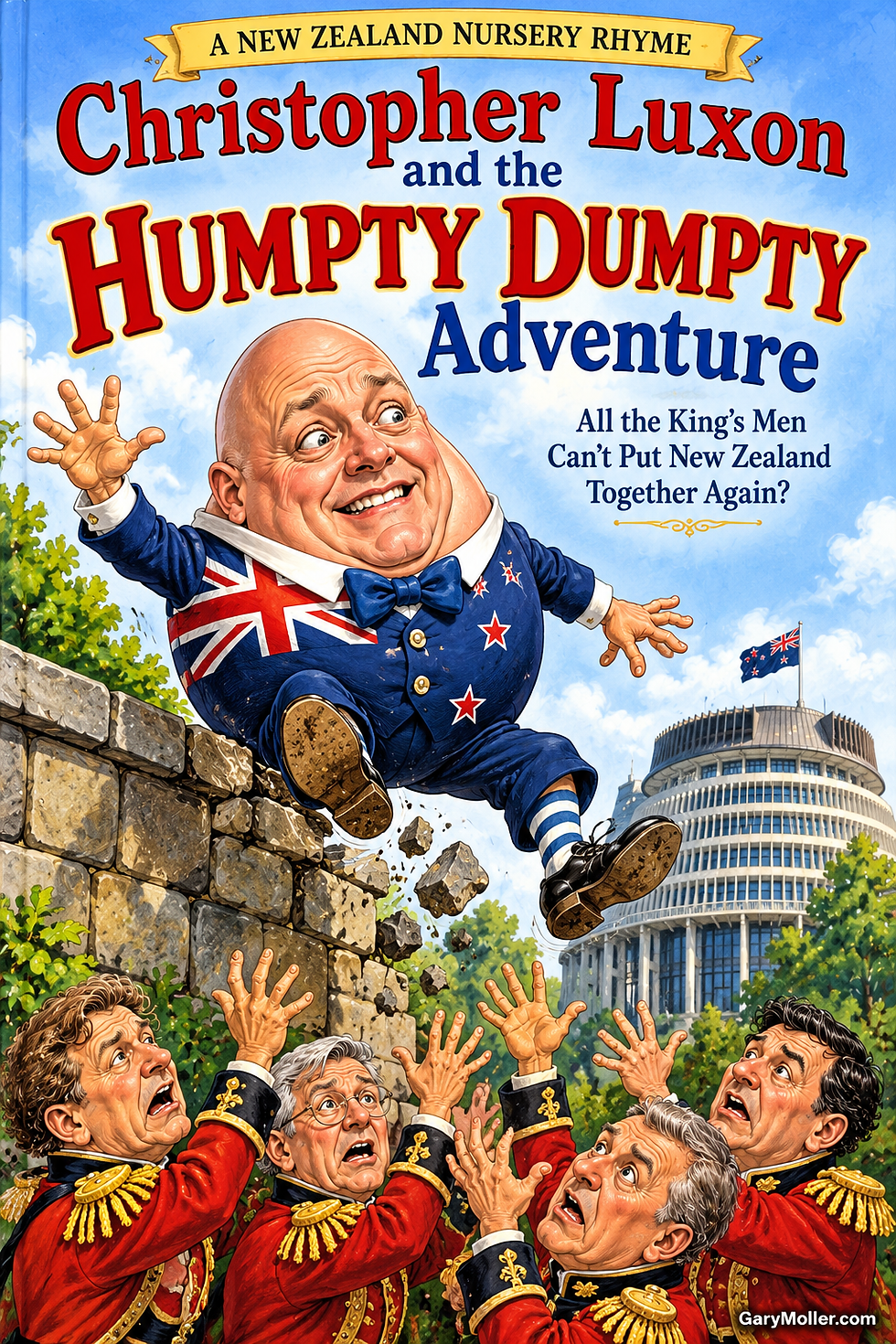
Imagine you own an enterprise you have built from the ground up through years of toil, personal financial risk, and sacrifice. It could be a local fish-and-chip shop, an orchard, a family farm, an engineering firm, or a major export business.
Now imagine you must leave the country for a mandatory six-month break in a remote location where communications are cut off and you cannot intervene in day-to-day decisions. Before boarding your flight, you must select one of the political leaders currently courting your vote and hand over complete operational control: the keys to the premises, banking permissions, staff oversight, and strategic authority.
Would you sleep soundly, confident that your business would not merely survive, but thrive?
Would operating cash flows cover ongoing overheads, or would you return to find creditors at the door?
Would plant and equipment be maintained, or run down to artificially flatter short-term numbers?
Would morale remain high, or would staff have fled mismanagement?
Running a central government is not identical to running a commercial enterprise. The state must care for vulnerable citizens, enforce the rule of law, and fund long-horizon public goods whose returns take decades to bear fruit. Nevertheless, the underlying virtues—competent operational execution, financial discipline, prudent risk management, and ethical stewardship—are identical. A candidate’s past track record running departments, budgets, or organisations remains the most reliable indicator of how they will handle the public purse.
2. The Balance Sheet Test: Are We Actually Better Off?
A critical question often sidelined in the rush of three-year election cycles is straightforward: Is New Zealand a better place to live, raise a family, work, and retire than it was twenty years ago?
Being better off cannot be measured simply by consumer technology, newer vehicle fleets, or rising residential real estate valuations. Genuine progress is measured by:
Household financial resilience and real wage growth;
Housing affordability for first-time buyers;
Timely access to world-class healthcare;
Educational outcomes in primary and secondary schools;
Safe, cohesive communities; and
Expanding economic horizons for the next generation.
Examining the Nation's Ledger: 2006 vs. 2026
Evaluating the nation requires examining the balance sheet just as an auditor scrutinises a corporate enterprise. According to Treasury data, New Zealand’s fiscal trajectory over the past two decades highlights significant shifts:
Indicator | June 2006 | June 2026 |
Net Core Crown Debt | ~NZ$7.7 billion | ~NZ$186.8 billion |
Net Debt as a % of GDP | 4.9% | 40.9% |
Per Capita Net Debt (Pop. ~5.36M) | ~NZ$1,800 | ~NZ$34,900 |
Illustrative Burden per Worker (~2.8M workforce at NZ$300B Gross Debt) | — | ~NZ$107,000 |

Borrowing is not inherently reckless. In business, debt is a powerful lever when deployed into capital projects that generate positive returns, expand productive capacity, or improve operational margins. In public administration, debt is sensible when funding resilient transport infrastructure, high-spec hospital wards, or educational facilities that serve generations.
The central issue is what the country received in exchange for an additional NZ$179 billion in net obligations. Have core public services noticeably improved? Are arterial roads, rail corridors, and drinking water assets resilient and modernised? Or have successive administrations used sovereign debt to cover recurrent structural operating deficits that current tax revenue could not support? Was spending $70 billion of borrowed money by the previous Labour Government on COVID vaccines a good investment? What would the country be like if that money had been spent on infrastructure such as roads, hospitals and schools? To illustrate what I am asking, $70 billion is equivalent to about 40 to 50 Transmission Gully road projects.
With an ageing demographic profile and a shrinking ratio of active taxpayers relative to dependants, carrying elevated debt without corresponding gains in national productivity places an unsustainable burden on future generations.
3. The Electoral Arithmetic Test: Mastering the Split Vote Under MMP
Good intentions and preferred policies are only half the equation; understanding New Zealand’s Mixed Member Proportional (MMP) electoral system determines whether your ballot actually delivers the government you intend to build.
Under MMP, every elector holds two distinct votes:
The Party Vote: Determines the total share of parliamentary seats each qualifying party receives.
The Electorate Vote: Chooses the individual candidate who wins your geographic constituency by first-past-the-post plurality.
Because these mechanisms operate under entirely different mathematical rules, treating both votes as a reflex package deal often undermines the voter's actual goal. In competitive elections, tactical vote-splitting provides a blueprint for maximising electoral leverage. To live out this logic effectively, voters should apply two clear rules at the ballot box:
Rule 1: Use Your Party Vote on a Viable Coalition Partner
Identify which of the two major parties—National or Labour—you prefer to see leading the next government. Rather than defaulting your party vote to that major party, cast it for the minor party you wish to see as their governing partner, provided that minor partner is capable of clearing the 5% threshold.
Under MMP, major parties will consistently clear the threshold and capture a solid base of electorate seats. However, a governing majority almost always requires coalition partners. If a minor party falls just short of the 5% mark (say, 4.8%), all of those votes are erased from Parliament entirely, collapsing the wider bloc’s numbers. By strategically directing your party vote to bolster a viable minor party on your preferred side of the aisle, you help ensure they comfortably clear the threshold, lock in critical coalition numbers, and bring key policy priorities into the governing arrangement.
Rule 2: Use Your Electorate Vote Defensively to Shut Out the Opposition
In electorate contests, proportionality does not apply; the candidate with the most votes wins, and second place gets nothing.
Therefore, cast your electorate vote pragmatically for the candidate most aligned with your politics, and most likely to defeat the candidate you least want representing your electorate. Voting for a third-party or fringe candidate in an electorate seat where they have no viable path to victory fractures the local vote, effectively handing the seat to an opponent on a split minority. Using your local vote as a defensive firewall prevents unwanted candidates from securing a parliamentary foothold. For me, the hardest decision will be how I cast my electorate vote, rather than my party vote.
The Future We Should Be Aiming For
The collective ambition for New Zealand should be clear: an economy dynamic enough to support high-wage jobs and productive enterprises, affordable housing, safe neighbourhoods, and high-performing public services that provide genuine value for every dollar collected.
Achieving that requires looking well beyond short-term political cycles. Before casting a ballot in 2026, every voter should weigh these central questions:
Stewardship: Would you trust these leaders with the keys, bank accounts, and management of your own business for six months?
Value: Do their policy platforms offer a credible strategy to expand national wealth and repair the public balance sheet, rather than funding short-term spending out of future debt?
Strategy: Does your voting plan execute the mathematical reality of MMP—anchoring your preferred governing bloc by lifting a viable minor partner with your party vote, while using your electorate vote to block unwanted representation locally?
Democracy benefits from sharp wit and good humour, but governing demands fiscal discipline, competent execution, and tactical clarity at the ballot box. New Zealand is not someone else's company—it belongs to all of us.

Comments