


Pain Management After Injury: Understanding Pain and the Gate Theory

Updated: Sep 16
First published 13th April 2026: updated September, 2026
How pain works, why it can worsen after injury, and practical ways to reduce suffering while the body heals

Pain Management After Injury: What My Injury Taught Me
Pain management after injury becomes much easier when you understand what pain is actually doing. Pain is not simply a direct measure of tissue damage. It is a protective experience produced by the nervous system, and its intensity can be influenced at several points between the injured tissue and the conscious brain. This is the basis of the gate theory of pain.
As I write this, I'm back in New Zealand after spending a month in a remote part of Chile, in the Andes. I had gone there to compete in the UCI Masters Mountain Biking World Championships. During early training on the course, I fell from a height onto very hard ground and lost consciousness. I hurt my neck and back.
The injury involved a severe sprain to the neck and upper back, with nerve irritation causing pain radiating down both arms. I also had severe headaches and widespread pain throughout my upper back, particularly in the cervical and thoracic regions. At times the pain was borderline unbearable, especially at night, when the nervous system seemed to amplify every signal. This kind of injury had the usual symptoms: stiffness, tiredness, disturbed sleep, and a feeling that the whole body was stressed.
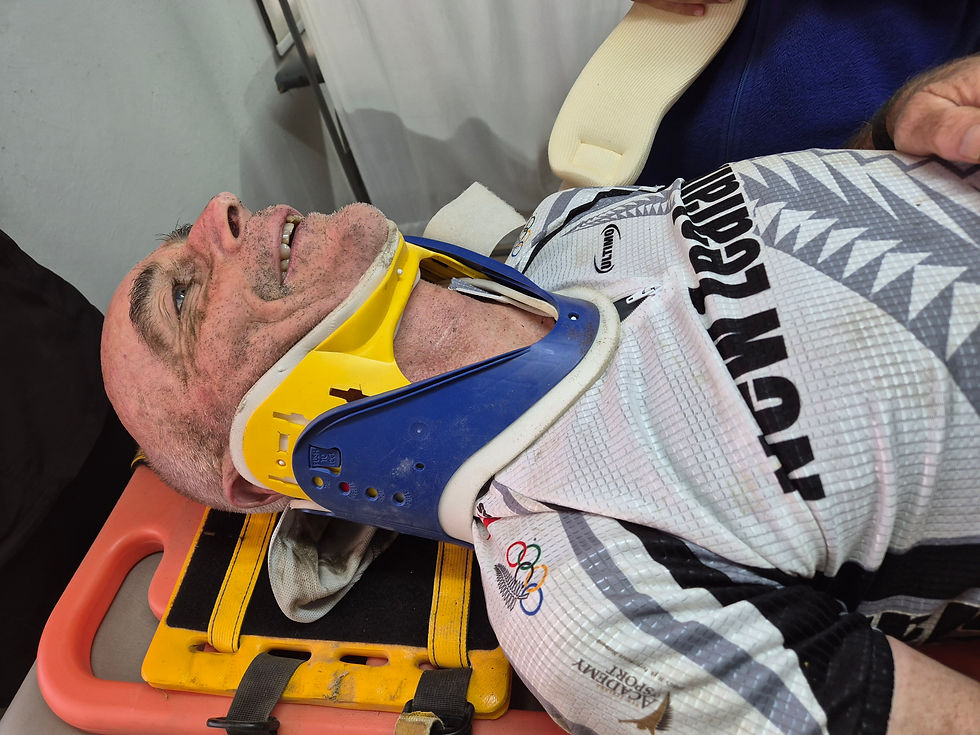
Because of the remoteness of the location, the decision about what to do next had to be made carefully. Immediate evacuation to a hospital would have involved a day-long and physically demanding journey down the mountain, followed by waiting, assessment, and imaging in a busy medical facility, plus language challenges (I do not speak Spanish and very few of the locals spoke any level of English). Instead, drawing on my experience in emergency medicine, including considering the mechanics of the crash, the protective equipment I was wearing, the symptoms I was experiencing, and my ability to move and function, I made the decision to rest completely onsite in a cabin for several days before attempting that journey. In any other circumstances, it would have been the immediate evacuation by ambulance to the nearest hospital. What I am saying here is this: My circumstances were exceptional and unusual. Get medical help for anything other than minor injuries.
For the first week, I was largely confined to bed. Even rolling over was a major effort, and getting up to go to the bathroom required assistance. During this time, especially the first 24 to 36 hours, Alofa and I watched closely for any signs of getting worse than would be the normal course of these kinds of injuries. Signs to look for include getting weaker, signs of paralysis, having trouble remembering things, getting worse headaches, or losing control of my bladder or bowels. My symptoms gave me confidence that the injury, although severe and disabling, was stable. For pain medication, I had to make use of what little choice there was from the village's general store. This included the Chilean versions of Panadol, Ibuprofen, and a Diclofenac cream — not ideal, but better than nothing.

Only once stabilised — a week later — did I make the long journey to hospital for imaging and medical assessment. The scans confirmed there was no fracture or instability, but there was significant soft tissue injury and nerve irritation. Even so, the journey, the waiting, and the images left me very tired, even though I was very physically fit and could handle pain quite well. In hindsight, it was the right thing to let the body calm down first, stabilise, and delay the journey until it could be done safer. Of additional interest is my vocal chords are affected with my voice noticeably weak on some days and when I am tiring.

It is also worth noting that what likely saved me from a far more serious outcome, even being confined to a wheelchair, was the instinctive use of a tuck and roll technique, something I have practised and demonstrated over many years. Unfortunately, the fall was from a height, headfirst onto very hard ground, and there was no way to avoid being badly hurt. However, without that automatic response, the outcome could easily have been catastrophic. It is a reminder that how we move, how we fall, and what we train for can make the difference between a serious injury and something far worse.
It is now six weeks since the injury. I'm finally back in New Zealand and working on rehabilitation. I'm taking medicine, but I'm also doing physical therapy, and taking the right nutrients. I can't express how relieved I am to be home.
It is worth noting that I am still working through ongoing symptoms, including headaches, muscular and spinal pain, numbness and tingling in the hands, and some muscular weakness. It is not a straight line. There are good days and bad days, but the overall direction is moving forward, with small, steady improvements each day. If one focuses only on today, and not the overall trends, panic and depression may take hold and become overwhelming.
This experience has been a very practical reminder of the science of pain, how the nervous system processes injury, and how important it is to understand what is happening rather than panic when pain becomes severe.
What you practise in training becomes what protects you when things go wrong.
Why pain often gets worse before it gets better
One of the most distressing aspects of injury is that pain does not always follow a simple pattern of steady improvement.
In many cases, particularly with soft tissue injury and nerve irritation, the worst pain may occur several days after the accident, not on the first day. This reflects the body's inflammatory response, which builds over time and sensitises the nervous system. This is similar to what happens after an unfamiliar exercise is done to excess. A person may feel relatively normal the next day, only to become significantly more sore two or three days later. With nerve irritation, the timeline may be longer and more intense, peaking at ten days or more.
In my case, the pattern was fairly clear. Severe stiffness and near immobility dominated the first week. There came increasing nerve pain down both arms. After that there was gradually improved movement, but persistent pain, especially at night. From there, it became a matter of small, steady gains rather than dramatic improvement.
Understanding this pattern is critical. Pain increasing does not necessarily mean damage increasing. It may simply mean that inflammation and nerve sensitisation have peaked. I'll repeat that: in the case of nerve pain, it may peak at around 10 days, after which it can be expected to decrease gradually. Understanding this is important because it is easy to become depressed, despondent, and even panic as the pain increases during that first week or so post-injury.
The instinctive response — the sheep through the gates analogy
A common and almost instinctive response to a painful injury is to rub immediately or hold the affected area. If you hit your elbow, strain a muscle, or jar your neck, your hand goes straight to the spot. This is not simply a habit. It is physiology.
By rubbing the skin and surrounding tissue, you send a flood of sensory signals back to the brain. Signals from touch, pressure, and movement begin to compete with pain signals coming from the injured tissue.
In the model I am using here, these incoming sensory signals we are creating when we vigorously rub the skin, are the black sheep (helpful sheep — the white sheep are the "pain" signals). The black sheep do not stop the pain entirely, but they make it harder for the pain signals, the white sheep, to dominate. In effect, they dilute and crowd out some of the intensity. Importantly, only so many sheep can pass through the sensory gates in the pathways from the site of injury to the conscious mind. The more black sheep that are added to the flock, the fewer white sheep can pass through each gate at any moment. This means that the conscious mind feels less pain.

This simple action is one of the most basic and powerful demonstrations of how pain can be modulated. It leads directly into the gate theory of pain.
The original gate control theory focused particularly on processing within the spinal cord. I use the term “gates” more broadly here as a simple analogy for the many places where pain signalling can be increased, reduced or modified between an injury and our conscious experience of it.
The gate theory of pain
Pain signals do not travel in a straight, uninterrupted line from the site of injury to the brain. Instead, they pass through multiple processing points, often called gates, within the nervous system.
Typical gates exist at:
The site of injury
The peripheral nerve
The spinal cord
The brainstem
The brain itself
Into consciousness
At each of these levels, the signal can be amplified, dampened, delayed, filtered, or partially blocked. Think of pain signals as sheep moving through a series of farm gates towards the brain. The things we add to make the pain less extreme are, in fact, all the different signals that fill those gates. They are not drugs. They are things such as:
Movement
Touch
Massage
Heat
Cold
Conversation
Reading
Sound
Visual stimulation
Laughter
Concentration
And focused activity.
These do not close the gate. They simply make it harder for the white sheep to get through.
The farmers at the gates are the medications and medical treatments. They partially close different gates, depending on what they are designed to do.
This is why pain management works best when more than one strategy is used at the same time. Some approaches reduce the number of white sheep leaving the injury site. Others partially closed gates along the way. Others bring in more black sheep to crowd the system.
TENS and the Gate Theory of Pain
Transcutaneous Electrical Nerve Stimulation, or TENS, is a very practical example of the gate theory of pain. By sending a steady stream of light electrical stimulation through the skin, it sends non-painful sensory input into the nervous system. This input effectively competes with, and "crowds out", some of the pain signals travelling along the same pathways. The nervous system can only handle so much at once. The extra sensory input helps reduce what gets to the brain in the form of pain signals.
This is why TENS can provide useful, short-term relief, particularly when pain is constant and wearing. However, it is important to understand that it is managing perception, not fixing the underlying cause. Used wisely, it can create a window of relief that allows better movement, rest, and rehabilitation. A health professional should guide the device selection and its use. This will make sure it is the best machine for the job, and placed correctly, in the right place, and used for the best benefit.
Pain is your friend — until it isn't
It is worth stepping back and recognising something that is often overlooked.
Pain is your friend. Pain is one of the body's most important survival tools. Without it, we would very quickly do serious damage to ourselves without even realising it.
Pain tells you when to pull your hand away from a hot plate. It tells you to stop loading an injured limb. It forces you to protect damaged tissue so that healing can begin. In the early stages of an injury, pain is doing exactly what it is supposed to do. It limits movement, encourages rest, and protects the injured area from further harm.
As healing progresses, pain also acts as a guide. It tells you when you can begin to move again, how far you can go, and when you have done enough. In the long run, it may even remind you, years later, that a joint or area has been hurt in the past and needs more care. In that sense, pain is not the enemy.
The problem arises when pain outlives, or exceeds its usefulness. When it becomes unrelenting, out of proportion, and unforgiving, it stops being a helpful signal and becomes something else. It becomes suffering. Pain is a protective signal. Suffering is an experience. And it is suffering that we should aim to reduce.
The strategies in this article are not about eliminating pain altogether. They are about reducing excessive signalling, calming the nervous system, and restoring a sense of control. In simple terms, respect pain when it is useful, and manage it when it becomes overwhelming.
The different gates and how treatment works at each one
The site of injury
This is where the pain begins. Damaged tissue releases inflammatory chemicals. These activate pain receptors and generate the first wave of signals. At this level, the main issue is inflammation, swelling, local muscle guarding, and tissue irritation.
Pain is a protective signal. Suffering is an experience. And it is suffering that we should aim to reduce.
Treatments working here include:
Anti-inflammatory drugs such as ibuprofen, diclofenac, ketoprofen, and naproxen
Topical anti-inflammatory gels such as diclofenac gel
Rest, support, sensible positioning, and graduated movement
Heat or cold, depending on timing and what gives relief
Red light therapy
These reduce the number of pain signals being generated at the source. In the sheep model, they reduce the number of white sheep leaving the paddock in the first place.
The peripheral nerve
Once a nerve becomes irritated, inflamed, or compressed, it may start sending signals that are too many, constant, and sometimes too loud. This is especially true with spinal nerve irritation, which can cause pain down the limbs, numbness, tingling, burning pain, and weakness.
Treatments working here include:
Neuropathic pain medicines like gabapentin and pregabalin can be given.
In some cases, selective nerve root blocks can be used to reduce inflammation around the nerve, including steroid treatment under medical advice.
These treatments make it harder for the irritated nerve to keep firing excessively. They reduce the number and intensity of white sheep travelling onwards.
The spinal cord
The spinal cord is one of the most important sites (gates). This is where pain signals can be amplified or dampened before they move further up the system.
Treatments working here include:
Sleep medications like zopiclone are sometimes used for nerve pain, but they are also used for mood.
Opioids do not usually remove the cause of pain, but they can reduce transmission through the central nervous system. Muscle relaxants don't remove the injury, but they may reduce the pain from muscles that are tight around the injury.
The brainstem
The brainstem plays a major role in modulating incoming pain signals. It is also closely linked to sleep, stress, vigilance, and arousal.
Treatments working here include:
Sleep medications like zopiclone are sometimes used for nerve pain, but they are also used for mood.
These medications are often used for both nerve pain and mood disorders.
Fatigue and sleep loss make the system more sensitive. The worse one sleeps, the more open the gates can feel.
The brain itself
This is where pain becomes a conscious experience. The brain understands signals, weighs threats, and determines how strongly the pain is felt.
Treatments and strategies working here include:
Good sleep support, including medication
Breathing and calm techniques
Talking
Reading
Writing
Listening
Focused activity can help you sleep better. Medications that affect central sensitivities or sleep may also help you sleep better.
This is also where fear, uncertainty, and stress can worsen pain. Not because the pain is imaginary, but because the brain is part of the pain system.
The main categories of pain medication
To make this practical, and at the risk of repetition, it is useful to classify the main categories.
Anti-inflammatory drugs
These are generally used to reduce inflammation at the source. They are often most helpful in the early and middle stages of an injury, when swelling and inflammation are the main cause of pain.
Examples include ibuprofen, diclofenac, ketoprofen, and naproxen.
These work mainly at the tissue level, though they also reduce the broader inflammatory burden feeding into the nervous system.
Opioid pain medications
These work mainly at the spinal cord and brainstem level. They reduce transmission and alter how pain is experienced.
Examples include codeine, tramadol, and morphine.
They can be useful, but they also come with downsides such as drowsiness, constipation, cognitive clouding, reduced coordination, and dependency risk. For that reason, they should be used thoughtfully and not treated as the only answer.
Neuropathic pain medications
These are specifically aimed at abnormal nerve signalling. They are often better than regular painkillers when pain is burning, shooting, radiating, tingling, or electrical.
Examples include gabapentin and pregabalin.
These are often more useful for nerve root irritation than standard anti-inflammatories or simple analgesics alone.
Muscle relaxants
These do not usually fix the problem, but they may reduce secondary pain caused by muscular spasms and guarding.
Examples vary by country, but the principle is the same.
Sleep medications
These may not be painkillers, but they help the body deal with pain by letting it sleep. When pain is worst at night, sensible use of sleep support can sometimes make a major difference.
Local anaesthetics and injection-based treatments
These include local anaesthetic injections, nerve blocks, and epidural injections. These are more specialised and usually reserved for more severe or persistent cases, but they can be very useful because they partially close a gate very directly.
Medication is only part of pain management
Medication is important, and in severe pain it can be essential. But it is not the complete answer. Each medication acts at a particular level. None of them should ever fully close one, or all of the gates. With the right combination of medications, by partially closing some of the gates, pain is lessened to tolerable levels.
Medication also carries risks. Depending on the type used, these can include:
Stomach irritation and digestive upset
Drowsiness
Cognitive impairment
Dependency
Reduced coordination
Mental clouding
Constipation
Liver and kidney harm
Poor balance
This is one reason why the aim should never be blind dependence on medication. Instead, our strategy should be a smart, strategic use of medicine, along with all the healthy ways to affect the pain system without medication.
Keeping busy — creating more helpful sheep to dilute the flock of unhelpful ones
In simple terms:
Keep busy. Not busy in a way that hurts more and stresses the injury, but busy in a way that engages the brain and floods the nervous system with healthy competing signals.
During this injury, I found that pain was worst when lying awake, idly thinking about it, feeling it, and bracing against it.
Pain reduced when I was:
Listening to podcasts
Watching or listening to videos
Talking with other people
Reading
Writing
Walking gently
Doing light exercises within reason
Having a warm bath or spa
Being outdoors
Focusing on a task
Writing this article itself has been part of that strategy. This is not a denial. It is practical neurophysiology. It is the deliberate creation of more black sheep, relative to the white ones (the ones representing the pain signals).
Why night-time pain is often the worst
This deserves special mention because it is one of the hardest features of injury-related pain to cope with. Pain often becomes worse at night because:
There is less distraction
The body is still and muscles stiffen
Circulation is less
Inflammatory chemistry is more noticeable
Fatigue lowers pain tolerance
There are fewer black sheep competing with the white sheep
This does not mean the injury is suddenly getting worse every night. It means the gates are less crowded and the nervous system is more sensitive. Understanding this helps stop a person from becoming frightened by the pattern.
The role of psychological support
Severe pain tests both the body and the mind. That does not mean the pain is psychological in origin. It means that the experience of pain affects the whole person.
Understanding reduces fear. Reduced fear reduces stress. Reduced stress reduces pain.
Support from others, reassurance, good explanations, and the sense that one is not being dismissed are not optional extras. They are part of the treatment.
Pain is always real — not imaginary
Some systems, including the ACC and the people who advise them, tend to rely too much on psychological explanations when pain keeps coming back. That is wrong.
Pain always has a physical basis somewhere in the system.
Tissues generate signals.
Nerves transmit signals.
The brain processes those signals.
All three are real.
Psychological factors may influence pain, but they do not create a cervical nerve root injury out of thin air. They do not create tissue damage, ligament strain, muscle spasm, or inflammatory changes. What they can do is magnify or reduce the experience of pain, which is not the same thing. A person can have real physical pain, while also feeling stress, fear, frustration, sleep problems, and feeling tired from living with it. One does not cancel out the other. When this difference is not understood, people can feel blamed, ignored, or treated like their suffering is somehow a weakness. That is not only wrong. It can make things worse.
Stabilisation, rest, and the early stage after injury
In remote situations, an immediate evacuation is not always the best first step if there are no signs of an emergency. The priorities may be:
Stabilise the neck or spine
Rest
Stay warm
Eat and drink
Control pain
Monitor symptoms carefully
In my case, travelling immediately would likely have made the injury worse. Resting first allowed the body to settle before the stress of transport and hospital assessment.
Warning signs requiring urgent medical care
Anyone with a head, neck, or spinal injury should seek urgent medical help if there is:
Increasing weakness
Loss of coordination
Loss of bladder or bowel control
Worsening numbness
Confusion
Severe or worsening headache
Difficulty walking
Loss of consciousness
Severe, unrelenting pain that is escalating rather than settling
Fever or other signs of infection in the context of injury or intervention
These are the signs that suggest the situation may be moving beyond the normal, though unpleasant, healing process and into something more serious.
Final words
Recovery is rarely smooth. Pain may get worse before it improves. Progress may be slow. The nervous system may become over-protective. Sleep may be disrupted. The person may feel at times as though they are going backwards. Yet none of that necessarily means the outcome will be poor.
The goal is not to get rid of the pain instantly. The goal is to manage it intelligently
Close the gates where you can.
Increase the black sheep.
Use medication wisely.
Stay engaged.
Allow time for healing.
Pain is your friend when it protects you. It becomes suffering when it outlives its usefulness. The task is not to fear pain, but to understand it, respect it, and reduce the suffering that can come with it.
Recovery is a process, not an event.
Medical disclaimer
I am not a medical doctor. I have training and experience in sports medicine and rehabilitation, but I am not qualified to diagnose or treat medical conditions.
This article is provided for general education purposes only.
Anyone with an injury, severe pain, neurological symptoms, or worsening condition must seek proper medical assessment from a qualified medical practitioner.
Do not change medication without consulting the prescribing doctor.
If symptoms such as weakness, loss of sensation, loss of bladder or bowel control, confusion, or severe worsening pain occur, urgent medical care is required.
This information is intended to support medical treatment, not replace it.


Gary, this is a phenomenal article on pain and pain-management. I've not read anything as thorough and, in a positive way, entertaining because I learned with every paragraph. You wer given a hard road to get to this point but look at how much good you are doing for the rest of us, teaching while documenting your own injury. That you had a serious crash yet can break it down to minutes, days, and weeks for the aftermath, and create a pain source of material that hasn't been published up to now is a marvel of medicine. Maybe all of those years leading up to this point, with your history and knowledge, and now the crash, were training you to…
Hi Gary
Sorry to hear about your accident in Chile. Always hard when it happens in a foreign place, where health services are not readily available. Your article has been very encouraging, detailing all the medications for different aspects of the body and releases any guilt I always have in taking them to recover since recovery can be many months. Currently into my 9th month of a very painful frozen shoulder and neck (injury), as well as well as 10/10 knee pain past month, but medical gatekeepers such as Dr and physio have not referred me for an MRI, probably unless I pay for it at NZ$1300. The hospital physio where I had a ACC referral, failed to diagnose m…
Dear Gary, so sorry to hear off this terrible accident. The pain must be horrific. My sister fell and fractured her back (T2) and was recovering from that, when two months later she fell again and fractured at T3. So, her recovery is ongoing - she has been told at least six months. Wishing you a good recovery. (I do have a contact for medicinal CBD/THC). All the best. 🙏
Sorry to hear you are going through this, sounds like one hell of a crash! I wish you the best for a full and speedy recovery so you can get back on the horse, I mean bike.
So sorry to hear of your accident and injuries Gary. Praying for a speedy recovery for you! All the best.